Small teams can absolutely meet high security and compliance expectations—if they treat evidence as part of daily operations, not an annual deliverable. ITGS helps you set up a workflow where audits become simpler, risk becomes clearer, and security execution becomes repeatable.
Strengthen Security and Compliance Operations
Learn how ITGS helps you stay audit-ready by organizing controls, evidence, and approvals in one place. Discover best practices for building a repeatable audit workflow that reduces last‑minute scrambling and improves accountability.
 Alexia Holder
 Jessica Patel
February 1, 2026
Productivity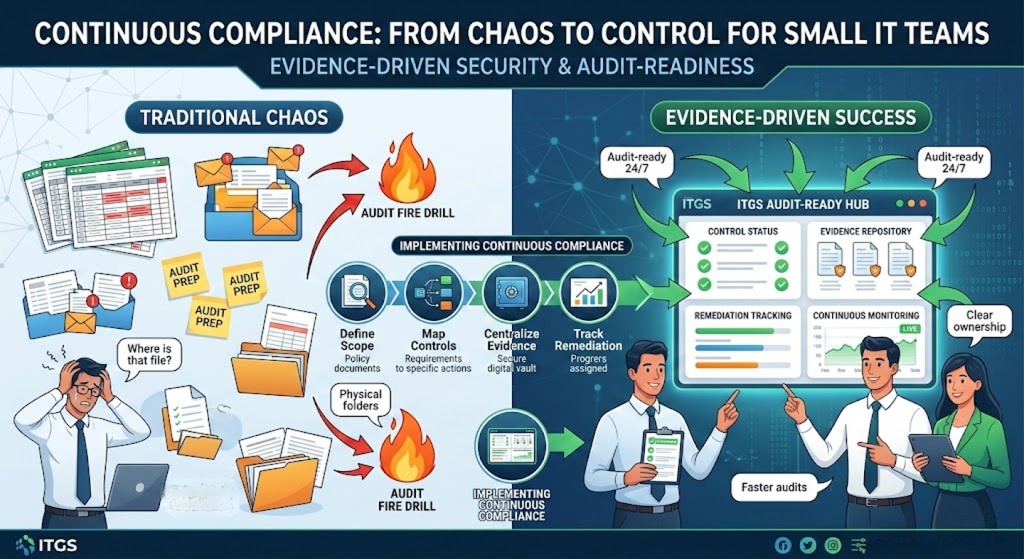
In today’s threat-heavy and highly regulated digital workplace, small teams are expected to move fast while still proving that security controls are in place and working. Teams don’t usually fail because they lack tools—they fail because evidence, ownership, and visibility are scattered across inboxes, tickets, and spreadsheets. For many organizations, the real goal is simple: stay secure, stay compliant, and be ready to show it at any time—without turning every audit into a fire drill.
This post explains a practical approach ITGS uses with clients: evidence-driven security and compliance. The idea is to run day-to-day security operations in a way that continuously produces audit-ready proof (policies, control status, logs, approvals, and remediation records), so compliance becomes a byproduct of good operations—not a last-minute project. Communications and operational records are often part of what regulators expect firms to retain and review, so having a deliberate capture-and-governance process matters.
What “audit-ready” really means
Being audit-ready isn’t about having perfect documentation once a year. It means you can answer, with confidence and supporting evidence:
What are our key risks and required controls?
Who owns each control and how is it monitored?
What changed, when, and who approved it?
Where is the evidence that demonstrates effectiveness?

In regulated environments, it also means you can retain and produce records (including digital communications and decision trails) in a way that supports supervision and compliance expectations.
Benefits for small teams
Small teams benefit the most from audit-ready workflows because they can’t afford duplicate work. When controls and evidence are managed continuously, you get:
Clear ownership: Everyone knows who maintains which controls and what “done” looks like.
Faster audits: Evidence is already collected, organized, and tied to requirements.
Better decisions: Risk is visible, prioritization is defensible, and remediation work is measurable.
Reduced operational noise: Fewer ad-hoc requests, fewer “where is that file?” moments, fewer last-minute scrambles.
How to implement it with ITGS
Here’s a simple way to roll this out without overhauling everything at once:
Define scope and requirements: Identify the standards/regulations you must meet and the systems in scope.
Map controls to reality: Translate requirements into конкрет controls your team can operate and measure.
Centralize evidence: Store artifacts, logs, exceptions, and approvals in a secure location with consistent naming and access rules.
Track remediation: Turn findings into actions with owners, deadlines, and verification steps.
Monitor continuously: Use dashboards/alerts to spot drift early and keep leadership informed.
Conclusion
FAQ
Do we need to be “fully compliant” before we start tracking evidence?
No—start where you are, capture what you have, and use gaps as prioritized remediation work.
What’s the fastest win?
Centralizing evidence with clear ownership (who provides what, how often, and where it lives).